
Business Case Modelling

Predicting the future can never come with guarantees but the ReEnergise in-house models consider more parameters, and in finer detail, than any other modelling we have yet encountered working within the Education Sector. Why does that matter?

In any project or programme of work there are plenty of pitfalls. Chief amongst them is avoiding wasting time or money on dead ends or expensive mistakes. Accurate, authentic modelling is an important ally in this endeavour.

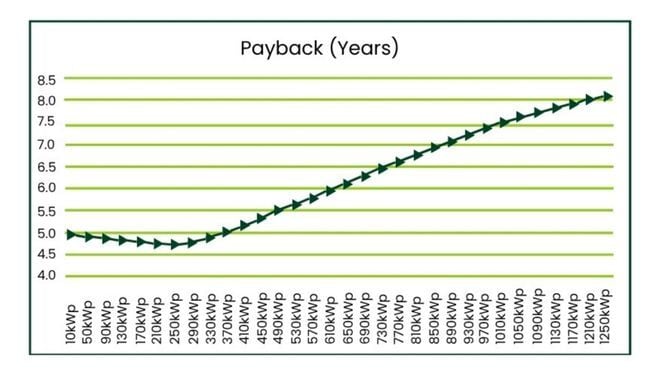
Here’s one example. We all know that solar PV can reduce a school’s reliance on expensive grid power and may pay back relatively quickly. But how much to install? This graph, from one of our models, shows the impact of different size arrays for the same site with a fixed demand.
bcm chart payback 1

The best payback in this case is 250kWp, meaning it would be a false economy simply to install as much solar as possible if the objective is to achieve the highest return on investment: it’s more cost-effective to match the scale of array to the demand profile of the site for the entire year.

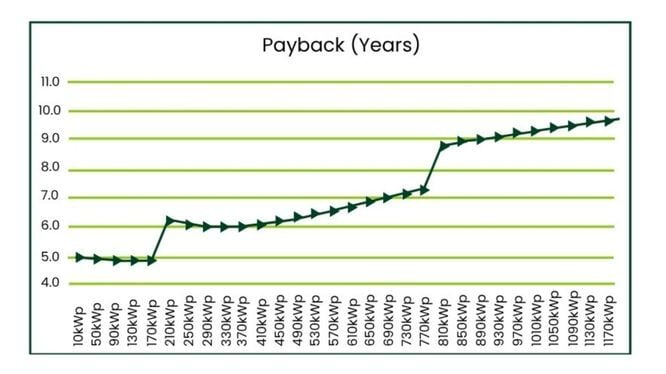
However, our modelling goes much further than the illustration above, important though that basic discipline is. The next graph takes account of other factors that can all too easily be forgotten: these could include the cost of automatic grid network management (ANM) and a substation upgrade as the array gets larger.
bcm chart payback 2

Now we can see that the fastest payback – for exactly the same site – is actually achieved at 170kWp. The lesson is that it’s good to invest in solar PV on this site but it’s best to invest in less than was originally thought. Only accurate, authentic modelling will reveal that.

Comprehensive modelling options

The above is but one example. Our Power Options Model can concurrently evaluate and compare several different on-site generation technologies. This matters: the default option often seems to be solar PV, but it may not be. In our more recent work networked combined heat and power is offering much higher returns on investment than solar PV, in the right situation. Likewise, wind turbines can be more effective, and the advent of small vertical axis wind turbines offers a system that is much less intrusive than the large, expensive cousins and will not incur the same planning constraints. Other technology options are also possible. Furthermore, it may require a combination of technologies to achieve the best return on investment. 

Our Business Case Model can evaluate a range of options, to identify the best course of action. It models Heat, Transport and Power Generation systems concurrently. It calculates lifecycle costs (installation, fuel, maintenance, future renewals) for up to 40-years. It gives detailed analysis of fuel consumption, taking account of system efficiencies and how these may change with time. System integration is included, so that any excess power generated (e.g., from Solar PV) is matched with the potential demand from other systems to accurately calculate any additional power required from the grid.

Options for financing can also be modelled, such as loans or energy purchase agreements. For example, if a contractor is offering solar as a service (no upfront cost) our modelling can establish if that represents good value for money or not.

Our fuel price forecasts are based on the latest market data and are reviewed and updated quarterly, but the model also includes sensitivity analysis to test the outcome for key uncertainties. This typically includes project cost, fuel price and fuel demand, but can include any parameter the client wishes.

Nothing about the future is guaranteed; but with our state-of-the-art modelling in support, a school is that much more likely to make the right investment choices.

Find out more about our services:
Strategic Planning

Many of our team have previous experience at senior levels in a range of public and private sector careers, operating at all corporate levels from central government and large listed companies to small start-ups. Between us we have acquired decades worth of strategic training and practice, which we now apply to our consultancy and project management work. From the largest estates to just a few buildings, we help clients move from uncertainty to a clear and deliverable pathway to meet their short, medium and longer-term energy related goals. Our core strategic product is the Energy Systems Masterplan. It assesses the Energy Trilemma trade-offs across the whole estate. The balance will vary depending on the client’s strategic goals but given what most currently seek it’s aptly described as the gateway to achieving savings on energy usage and increased energy security.

Financial & Carbon Modelling

We’re proud of our financial and carbon modelling capability. We have our own suite
of proprietary models to assess the combined effect of all the relevant energy
infrastructure interventions, with more granularity than we have encountered in any other models. Authentic, data-driven modelling is a critical component in plans,
business case analysis and budget forecasting.

Project Financing

We’ve recognised that clients often aspire to undertake the innovative engineering that we offer, because it will save them money and improve the operation of their estates: but they lack the capital to invest. To that end we’ve worked with a finance partner to develop funding packages that will significantly reduce the direct investment required by clients. The message to clients is clear: don’t be put off by a lack of capital to invest. We’ll collaborate to make it work. Inevitably the return on investment will not be as high as for self-financed projects, but it can still be much better than doing nothing.

Building Services Engineering

Building services engineering offers the means to turn strategic thinking into action. Our depth of knowledge of the relevant engineering systems and our forensic attention to detail combine to enable us to achieve unsurpassed results in project engineering. In support of this assertion, we are increasingly being called upon to intervene to put right systems that have failed through previous poor attention to
engineering detail. Being good at building services engineering also enhances our strategic output, enabling us to unlock the full potential of a given mix of technologies on an estate.

Project Management

We have extensive experience managing projects, from the optimisation of a single
plant room to the installation of large heat networks and conversion of multiple plant
rooms to different technologies. As well as keeping projects to time, budget and
quality, we major on health and safety. We also recognise that our clients need to be able to get on with their own daily challenges with minimal interruption.

Energy Broking

The addition of energy broking to our capabilities makes us ideally suited to
becoming an energy partner, covering all energy related services. The hallmark of our broking is strong advice on market timing and choosing the right type of contract, backed up by complete transparency: no hidden broker fees. One example: we’ve recently saved a multi academy trust 19% on their annual gas supply costs over the next 3 years, and that’s against a backdrop of a rising market due to the Iran War energy crisis. The result took them completely by surprise. On request, we can also provide account management support, including invoice validation. 

Compliance

 We are qualified to provide a wide range of energy related compliance services, including ESOS, SECR, EPCs, and DECs. Our aim is to shoulder the burden of this work for clients. For example, as well as completing the required surveys and reports, we will work with clients to keep track of due dates and provide timely reminders when reports are due. 

Heat Networks

 Our project track record means that we have acquired extensive experience in scoping, specifying, designing and managing the installation of heat networks, ranging in scale from networks linking a few buildings up to large sites with over 100 buildings and networks stretching over several kilometres. We see this as a growing capability in the company, as the demand increases in line with government policy.